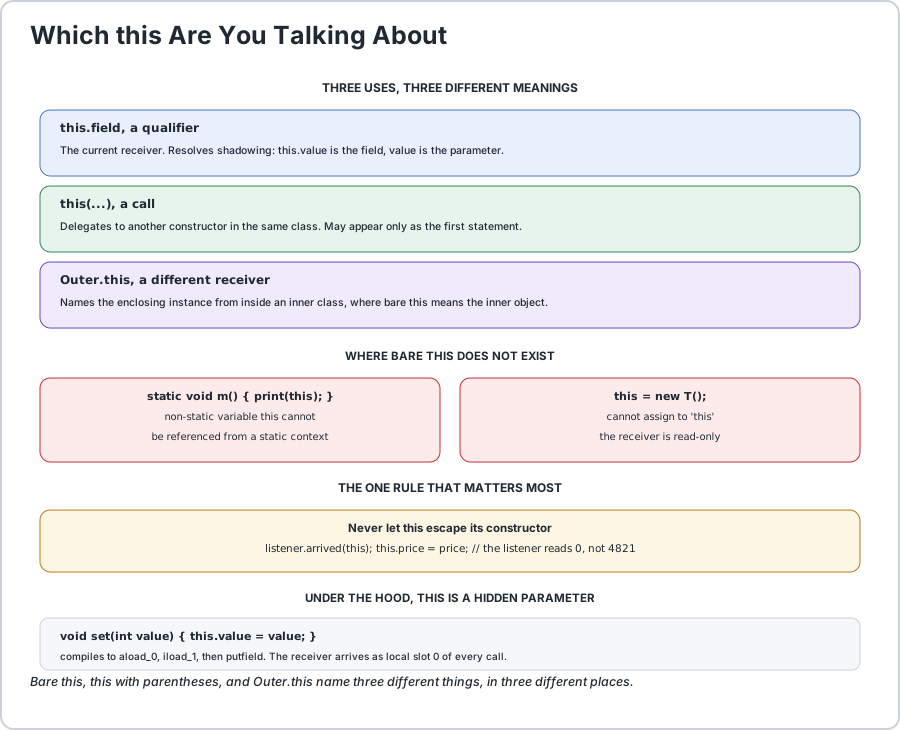
this earns its keep in exactly three situations: disambiguating a shadowed field, delegating between constructors, and returning the receiver for a fluent call. Outside those, an explicit qualifier is usually noise, and a design that needs Outer.this scattered through a file is usually a design whose classes have grown too close.
Two habits prevent the two expensive mistakes. Qualify a field access from inside a method whose parameter shares the name, because the alternative is a silent self-assignment that reads correctly. And treat any use of this in a constructor as suspicious, because the object is unfinished there by definition. The one habit that prevents the worst failure is to hand a built object to its listener rather than letting the constructor do the introducing.
When a class grows large enough that shadowing needs qualification everywhere, the usual fix is smaller classes and shorter parameter lists rather than more this. The keyword is at its best as a scalpel, not as wallpaper.
Frequently Asked Questions
What is the this keyword in Java?
It is a reference to the object the current method or constructor was called on. You did not declare it and you cannot redeclare or reassign it: it arrives with every instance call, roughly as if it were a hidden extra parameter, and javac implements it exactly that way, as local slot 0 of the call.
Why do I need this.name = name in a constructor?
Because the parameter is shadowing the field. The bare name name resolves to the nearest declaration, which is the parameter, so an unqualified assignment would set the parameter to itself and leave the field untouched. Qualifying with this reaches back through the receiver to the field.
Can this be used in a static method?
No. A static method has no receiver, so there is nothing for this to refer to, and the compiler reports that a non-static variable cannot be referenced from a static context. This is the same reason an instance field or method is unreachable from a static body without an object.
What is the difference between this and this()?
Bare this is the receiver, an expression you read or return. this(...) is a constructor call that delegates to another constructor of the same class, and it may appear only as the very first statement of a constructor. They share a spelling and nothing else.
What does Outer.this mean?
It names the enclosing instance from inside an inner class, where bare this means the inner object. The outer receiver is stored in a hidden field assigned when the inner object is created, which is why an inner object keeps its whole outer graph alive. From a static nested class there is no such field, so the qualified form is a compile error.
Do lambdas and anonymous classes treat this the same way?
No, and the difference is a real source of migration surprises. Inside a lambda, this is still the enclosing object, which is why a lambda is a good fit for event handlers that read outer state. Inside an anonymous class, this belongs to the anonymous object itself, which carries its own members.
Can this be assigned or null?
It cannot be assigned, and writing this = ... is a compile error naming the keyword. It is never null inside an instance method either, because the dispatch that reached the method already selected a real object. The receiver is fixed at the call and nothing in the body can change it.
Why must this() be the first statement in a constructor?
Because the object does not exist until something fills it, and delegation is that something. Putting another statement first would run code against an uninitialised receiver, which is exactly the failure the rule exists to prevent. The same first-statement rule applies to super, and the two can never appear in one constructor body.
What happens when this escapes its constructor?
Whatever receives it observes an unfinished object. Passing this to a listener, registering it, or starting a thread on it before the constructor's assignments have run lets the other side read fields at their type defaults. In the example on this page the listener reads price = 0 although the intended value was 4821.
Does making a field final protect it from early readers?
No. final guarantees the field is assigned exactly once, which the compiler enforces, but it says nothing about when anyone else reads it. If this escapes before that single assignment runs, even a final field reads as zero or null to the early reader. Order of statements, not modifiers, is what decides.