Topic 55 of 119 6. Object-Oriented Programming in Java Interactive Tutorial

Constructor Overloading in Java: Multiple Initialization Paths

15 mins read Last updated: 22 Aug 2026 27,653 views

Direct Answer & Core Concept

Constructor overloading lets a class offer several initialization paths through the new expression. Each overload differs in its parameter list, so the caller supplies exactly the state it cares about and the class supplies sensible defaults for everything else. Overloaded constructors follow the same signature rules as overloaded methods. They must differ in parameter count, type, or order. They cannot differ by return type, because constructors have none, and they cannot differ only by access modifier, since that produces the same signature. The technique only stays maintainable if the overloads delegate rather than repeat. One canonical constructor holds the validation and the field assignments, and every other overload calls it with this(...) as its first statement. Without that discipline the overloads drift apart: you fix a validation bug in one path and two other paths silently keep the old behaviour. There is also a ceiling worth knowing. Beyond roughly three parameters, overloads stop scaling, because each new field needs another constructor. At that point a static factory method, a record, or a builder is the better tool, and knowing where to stop is part of using overloading well.

Detailed Explanation & Mechanics

1) The Signature Rule

A constructor is overloaded when two of them differ in their parameter list. Count, type, and order all count; the name can never vary because every constructor shares the class name.

Main.java
Run Online
public Session() {
    this("anonymous", ROLE_GUEST, true);
}public Session(String username) {
    this(username, ROLE_GUEST, true);
}public Session(String username, String role) {
    this(username, role, true);
}public Session(String username, String role, boolean active) {
    if (username == null || username.isBlank()) {
        throw new IllegalArgumentException("Username is required");
    } if (!role.equals(ROLE_GUEST) && !role.equals(ROLE_ADMIN)) {
        throw new IllegalArgumentException("Unknown role: " + role);
    } this.username = username;
    this.role = role;
    this.active = active;
}

All four are legal because every signature differs. Try to add a fifth taking the same three parameters in a different order and you have a genuine difference, so that is also legal. Add one that differs only by returning a value and the compiler rejects it.

DifferenceDistinct overload?
Different parameter countYes
Different parameter typesYes
Same types in a different orderYes
Different return type onlyNo, constructors return nothing
Different access modifier onlyNo, same signature

2) Delegate, Do Not Repeat

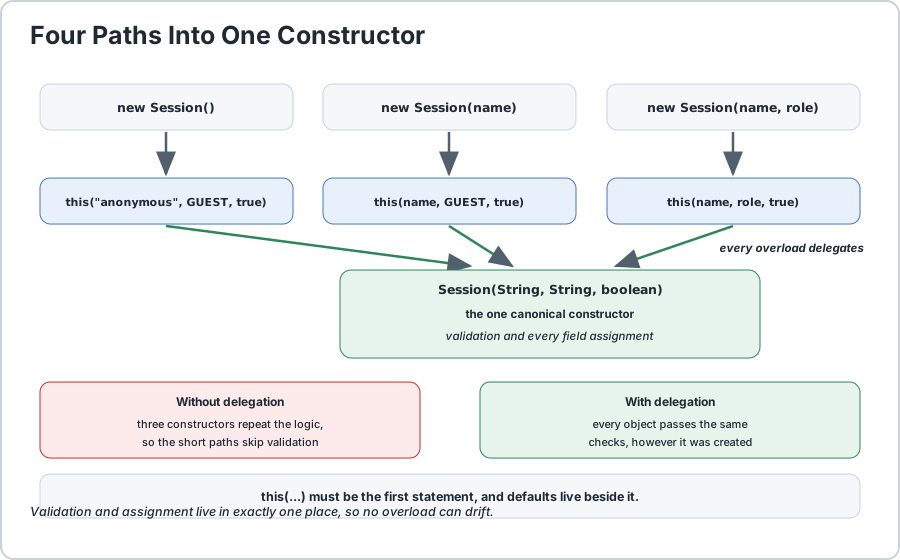
Every convenience constructor should end in a single this(...) call. That call must be the first statement of the body, because the compiler has to know which constructor the arguments belong to before anything else runs.


Diagram showing four overloaded constructors all delegating to one canonical constructor
Four paths into one constructor. Validation and assignment live in exactly one place.

Main.java
Run Online
// This is the version that drifts
public Session(String username) {
    this.username = username;
    this.role = ROLE_GUEST;
    this.active = true;
}public Session(String username, String role) {
    this.username = username;
    this.role = role;
    this.active = true;
}

Two problems with the version above. The validation exists only in the three-argument constructor, so a caller using either shorter overload bypasses it entirely. And when the rules change, you have to remember to update three places, and you will miss one.

Delegating is not merely a style preference. It guarantees that every object passes through the same validation, so an object created by any overload satisfies the same invariants. That is the entire point of encapsulating construction.

3) Defaults Come From One Place

Once delegation is in place, the defaults live beside the canonical constructor rather than being spread across the class. Adding a new optional field becomes a single edit.

Main.java
Run Online
private static final String ROLE_GUEST = "GUEST";
private static final boolean DEFAULT_ACTIVE = true;
// becomes, after adding a displayName field
public Session(String username) {
    this(username, ROLE_GUEST, DEFAULT_ACTIVE);
}public Session(String username, String role) {
    this(username, role, DEFAULT_ACTIVE);
}public Session(String username, String role, boolean active) {
    this(username, role, active, username);
}

Without delegation that change would mean touching every constructor, and forgetting one produces an object whose displayName is null while its username is set.

4) Ambiguity Is the Main Hazard

Because the choice happens at compile time from the static types of your arguments, some calls become ambiguous. Java reports this rather than guessing, but the error is often cryptic until you know what to look for.

Main.java
Run Online
public Report(String title) {
}public Report(String title, boolean landscape) {
}// AMBIGUOUS: a null could match either overload
Report a = new Report(null, null);

Boxing widens the problem. Because an int argument can match both a primitive and a boxed parameter, the compiler prefers the exact primitive match but rejects cases where neither is strictly better.

Attempted callResult
new Report() and new Report("t")Fine, both match exactly
new Report("t", null)Ambiguous between overloads
One overload takes int, another IntegerCompiles, resolves to the primitive
Two overloads with reversed primitive typesAmbiguous on any numeric call

Resolving an ambiguous call usually means being explicit at the call site: new Report("t", (Boolean) null). The better fix is often to remove the overload that creates the ambiguity, since two signatures that are hard to tell apart are hard for callers too.

5) Varargs Complicates Resolution

A varargs constructor matches any number of trailing arguments, which makes it an attractive catch-all and a frequent source of surprises. It is considered only after every fixed-arity overload fails to match.

Main.java
Run Online
public Tag(String... values) {
    if (values == null || values.length == ZERO_COUNT) {
        throw new IllegalArgumentException("At least one value is required");
    } this.values = values.clone();
}

Two details are easy to miss. A call with no arguments matches the varargs constructor, so new Tag() is legal and hands you an empty array unless you check it. And because the varargs array is created fresh by the compiler on each call, storing it without cloning lets a caller mutate your internal state through the array it already holds.

Always clone() a varargs array in the constructor. Passing null also arrives as null rather than an empty array, so a null check is required as well as a length check.

6) Copy Constructors Fit Here

A copy constructor takes a single argument of the same type, which makes it an overload like any other. It is the natural way to express duplication at the call site.

Main.java
Run Online
public Session(Session source) {
    if (source == null) {
        throw new IllegalArgumentException("Source cannot be null");
    } this.username = source.username;
    this.role = source.role;
    this.active = source.active;
}

It also lets you control what a copy means. If the class ever gains a mutable collection field, a naive copy constructor shares that reference between the original and the duplicate, so a change through one is visible through the other. Copying the container as well is what makes the duplicate genuinely independent.

7) The Limit of Overloading

Overloading works well up to about three parameters. Past that, the constructor count grows faster than the number of distinct states a caller actually wants, and the class becomes hard to read.

Main.java
Run Online
// This is what too many constructors look like
public Order(String customer, String product, int quantity, String address, String coupon, boolean expedited, String note) {
}

Seven parameters means seven overloads, most of which no caller uses, and any new field means revisiting all of them. At that point a different tool fits better.

ToolBest when
Overloaded constructorsTwo or three parameters, a few natural defaults
Static factory methodsThe name should differ from the type, or the type is an interface
BuilderMany optional parameters, or validation across them
RecordA pure data carrier needing no behaviour at all

A static factory method also solves a problem constructors cannot: a constructor is always named after its class, so List.of(...) is impossible while ListFactory.create(...) is fine. It can also return a cached instance or a subtype, which new never can.

8) Common Misconceptions

ClaimVerdict
Overloads can differ by return typeFalse. Constructors have no return type.
Overloads can differ by access modifierFalse. That is the same signature.
Overloads can have different namesFalse. All are named after the class.
Each overload may validate independentlyFalse in practice. Then validation drifts apart.
this(...) may appear anywhere in the bodyFalse. It must be the first statement.
A class may use this and super togetherFalse. Both must be first, so pick one.
Varargs accepts zero argumentsTrue. It hands you an empty array, so check it.
Overloads are chosen at run timeFalse. The compiler picks from static types.

Frequently Asked Questions

What makes two constructors overloads rather than duplicates?


They must differ in their parameter list, whether in count, type, or order. They cannot differ by return type, because constructors declare none, and they cannot differ only by access modifier, because that yields the same signature. Identical parameter lists with any other difference are a compile error.

Why should overloaded constructors delegate to one another?


So validation and assignment live in a single place. When every constructor repeats the logic, adding a rule means editing each one, and a path that was missed keeps the old behaviour while appearing to be the same class. Delegating guarantees every object satisfies the same invariants regardless of which overload created it.

Where must the this call be placed?


As the first statement of the constructor body. The compiler has to resolve which overload the arguments belong to before it can compile anything else, so no statement may precede it. For the same reason you may use either this or super, never both.

What causes an ambiguous constructor call?


It happens when more than one overload matches the argument types equally well, and the compiler refuses to guess. Passing null for a parameter present in several overloads is the usual cause, as is a numeric literal that could match either an int or an Integer overload. Cast the argument to disambiguate, or remove the conflicting overload.

Does a varargs constructor accept a call with no arguments?


Yes, and it receives an empty array rather than null. So a varargs constructor must check the length and reject an empty call if that is not a valid state. Passing an explicit null instead gives you a null array, so both checks are needed, and you should clone the array to stop callers mutating your internal state.

When should I stop overloading constructors?


When the parameter list grows past about three. Each added optional field would need another constructor, and most combinations go unused. At that point a builder for many optional fields, a static factory method when the name should differ from the type, or a record for pure data will be clearer and cheaper to maintain.

When is the constructor chosen?


At compile time, from the static types of the arguments, and never from the runtime type of the objects involved. This is why passing a short literal where both an int and a long overload exist silently selects the int rather than the more convenient long.

How does constructor overloading differ from method overloading?


Only in naming. Both are resolved at compile time from the parameter list, and both forbid differing by return type. The differences are that every constructor is named after its class, that constructors declare no return type, that constructors are never inherited, and that an explicit this call can delegate from one overload to another.
Runnable Code Example: Constructor Overloading in Java

Java 17+
Main.java
Run Online
// Constructor overloading with every overload delegating to one canonical path.
public class ConstructorOverloadingDemo {
    private static final String ROLE_GUEST = "GUEST";
    private static final String ROLE_ADMIN = "ADMIN";
    private static final boolean DEFAULT_ACTIVE = true;
    private static final int ZERO_COUNT = 0;
    private static final String TITLE_REPORT = "untitled";
    // STATE: every field is final, so the class is immutable
    public static class Session {
        private final String username;
        private final String role;
        private final boolean active;
        // NO-ARGUMENT: the most convenient starting point
        public Session() {
            this("anonymous", ROLE_GUEST, DEFAULT_ACTIVE);
        } // USERNAME ONLY
        public Session(String username) {
            this(username, ROLE_GUEST, DEFAULT_ACTIVE);
        } // USERNAME AND ROLE
        public Session(String username, String role) {
            this(username, role, DEFAULT_ACTIVE);
        } // THE CANONICAL CONSTRUCTOR: the only place fields are assigned
        public Session(String username, String role, boolean active) {
            if (username == null || username.isBlank()) {
                throw new IllegalArgumentException("Username is required");
            } if (!ROLE_GUEST.equals(role) && !ROLE_ADMIN.equals(role)) {
                throw new IllegalArgumentException("Unknown role: " + role);
            } this.username = username;
            this.role = role;
            this.active = active;
        } // COPY CONSTRUCTOR: an overload taking one argument of this type
        public Session(Session source) {
            if (source == null) {
                throw new IllegalArgumentException("Source cannot be null");
            } this.username = source.username;
            this.role = source.role;
            this.active = source.active;
        } public String getUsername() {
            return username;
        } public String getRole() {
            return role;
        } public boolean isActive() {
            return active;
        } @Override public String toString() {
            return username + " [role: " + role + ", active: " + active + "]";
        }
    } // AMBIGUITY: a null second argument matches only the landscape overload
    public static class Report {
        private final String title;
        private final boolean landscape;
        public Report(String title) {
            this(title, false);
        } public Report(String title, boolean landscape) {
            if (title == null || title.isBlank()) {
                throw new IllegalArgumentException("Title is required");
            } this.title = title;
            this.landscape = landscape;
        } @Override public String toString() {
            return "Report[" + title + ", landscape: " + landscape + "]";
        }
    } // VARARGS: matches any number of arguments, including none at all
    public static class Tag {
        private final String[] values;
        public Tag(String... values) {
            // a null array arrives as null, and no arguments arrive as empty
            if (values == null || values.length == ZERO_COUNT) {
                throw new IllegalArgumentException("At least one value is required");
            } // clone, so the caller cannot mutate our state through its array
            this.values = values.clone();
        } public int size() {
            return values.length;
        } @Override public String toString() {
            return "Tag" + java.util.Arrays.toString(values);
        }
    } // A STATIC FACTORY: the tool to reach for past a few overloads
    public static class Money {
        private final long amountInCents;
        private Money(long amountInCents) {
            if (amountInCents < ZERO_COUNT) {
                throw new IllegalArgumentException("Amount cannot be negative");
            } this.amountInCents = amountInCents;
        } public static Money ofCents(long amountInCents) {
            return new Money(amountInCents);
        } public static Money zero() {
            return new Money(ZERO_COUNT);
        } @Override public String toString() {
            return "Money[" + amountInCents + " cents]";
        }
    } public static void main(String[] args) {
        // FOUR WAYS TO REACH THE SAME VALID STATE
        Session anonymous = new Session();
        Session named = new Session("john_doe");
        Session elevated = new Session("admin_user", ROLE_ADMIN);
        Session explicit = new Session("john_doe", ROLE_GUEST, true);
        System.out.println(anonymous);
        System.out.println(named);
        System.out.println(elevated);
        System.out.println(explicit);
        // EVERY OVERLOAD PASSES THE SAME VALIDATION
        try {
            new Session("", ROLE_GUEST);
        } catch (IllegalArgumentException problem) {
            System.out.println("rejected blank username: " + problem.getMessage());
        } try {
            new Session("someone", "SUPERUSER");
        } catch (IllegalArgumentException problem) {
            System.out.println("rejected unknown role: " + problem.getMessage());
        } // THE COPY CONSTRUCTOR IS AN OVERLOAD LIKE ANY OTHER
        Session duplicate = new Session(elevated);
        System.out.println("copy equals source: " + duplicate.equals(elevated));
        System.out.println("copy is same object: " +(duplicate == elevated));
        System.out.println("copy: " + duplicate);
        // AMBIGUOUS CALLS AND HOW TO AVOID THEM
        System.out.println(new Report(TITLE_REPORT));
        System.out.println(new Report(TITLE_REPORT, true));
        System.out.println("a null boolean resolves: " + new Report(TITLE_REPORT,(Boolean) null));
        // VARARGS HANDLES ANY COUNT, INCLUDING NONE
        System.out.println(new Tag("java", "oop", "constructors"));
        try {
            new Tag();
        } catch (IllegalArgumentException problem) {
            System.out.println("rejected empty varargs: " + problem.getMessage());
        } // A STATIC FACTORY IS CLEARER PAST A FEW PARAMETERS
        System.out.println(Money.zero());
        System.out.println(Money.ofCents(2_499L));
        /*
            ACTUAL OUTPUT:

                anonymous [role: GUEST, active: true]
                john_doe [role: GUEST, active: true]
                admin_user [role: ADMIN, active: true]
                john_doe [role: GUEST, active: true]
                rejected blank username: Username is required
                rejected unknown role: Unknown role: SUPERUSER
                copy equals source: false
                copy is same object: false
                copy: admin_user [role: ADMIN, active: true]
                Report[untitled, landscape: false]
                Report[untitled, landscape: true]
                a null boolean resolves: Report[untitled, landscape: false]
                Tag[java, oop, constructors]
                rejected empty varargs: At least one value is required
                Money[0 cents]
                Money[2499 cents]

            THE SEVEN THINGS TO REMEMBER
            1) OVERLOADS DIFFER IN THE PARAMETER LIST, never by return type
               or access modifier, and never by name, since every
               constructor shares the class name.
            2) DELEGATE WITH this, DO NOT REPEAT. One canonical constructor
               owns the validation and the assignments, so every object
               satisfies the same invariants however it was created.
            3) DEFAULTS BELONG IN ONE PLACE. With delegation, adding an
               optional field means editing one constructor instead of
               every one of them.
            4) AMBIGUITY IS A COMPILE ERROR, not a silent choice. Passing
               null to a parameter that appears in several overloads is the
               usual cause, and a cast or a removed overload fixes it.
            5) RESOLUTION HAPPENS AT COMPILE TIME from the static argument
               types, so a short literal picks int over long without
               regard to what you would prefer.
            6) VARARGS MATCH ZERO ARGUMENTS TOO, handing you an empty array.
               Check the length, check for null, and clone before storing,
               or a caller can mutate your state through its own array.
            7) PAST ABOUT THREE PARAMETERS, SWITCH TOOLS. A static factory,
               a builder, or a record scales better than a growing pile of
               constructors most of which nobody calls.
        */
    }
}

Common Java Technical Interview Questions & Answers

Interview Prep
Q1: What makes two constructors overloads rather than duplicates?\nA1: They must differ in their parameter list, whether in count, type, or order. They cannot differ by return type because constructors declare none, and they cannot differ only by access modifier because that produces the same signature. Any two constructors with identical parameter lists and any other difference are a compile error.\nQ2: Why should overloaded constructors delegate to a single canonical one?\nA2: So validation and field assignment live in exactly one place. When every constructor repeats the logic, adding a rule means editing each one, and an overload that was missed keeps the old behaviour while still appearing to be the same class. Delegating guarantees that every object satisfies the same invariants regardless of which overload created it.\nQ3: Where must a this call be placed in a constructor?\nA3: As the first statement of the constructor body. The compiler must resolve which overload the arguments belong to before compiling anything else, so no statement may precede it. For the same reason you may use this or super in a given constructor, never both.\nQ4: What causes an ambiguous constructor call?\nA4: It occurs when more than one overload matches the argument types equally well and the compiler refuses to guess. Passing null for a parameter that appears in several overloads is the usual cause, as is a numeric literal that could match either an int or an Integer overload. Disambiguating requires an explicit cast at the call site, or removing the conflicting overload.\nQ5: Does a varargs constructor accept a call with no arguments?\nA5: Yes, and it receives an empty array rather than null, so a varargs constructor must check the length and reject an empty call if that is not a valid state. Passing an explicit null instead yields a null array, so both checks are needed, and the array should be cloned so a caller cannot mutate your internal state through the array it already holds.\nQ6: When should you stop overloading constructors?\nA6: When the parameter list grows beyond about three. Each additional optional field would require another constructor, and most combinations would go unused. At that point a builder suits many optional fields, a static factory method suits a name that differs from the type or an interface return, and a record suits pure data with no behaviour.\nQ7: When is the correct constructor selected?\nA7: At compile time, using the static types of the arguments, never the runtime types of the objects passed. This is why passing a short literal to a class with both int and long overloads silently selects the int rather than the more convenient long.\nQ8: How does constructor overloading differ from method overloading?\nA8: Only in naming and inheritance. Both resolve at compile time from the parameter list and both forbid differing by return type. Constructors additionally share the class name, declare no return type, are never inherited, and can delegate to another overload of the same class with an explicit this call.

Key Takeaways, Best Practices & Clean Code Rules

Java Best Practice & Production Rules

Design one canonical constructor holding all validation and field assignment.\nMake every other constructor delegate to it with this as the first statement.\nKeep defaults as named constants next to the canonical constructor, not inline literals.\nDo not repeat validation logic across overloads, since that guarantees it will drift.\nStop overloading past about three parameters and switch to a builder or a record.\nPrefer a static factory method when the name should differ from the type.\nUse a static factory when the method may return a cached instance or a subtype.\nClone a varargs array in the constructor so callers cannot mutate your state.\nCheck both null and length in a varargs constructor, since each arrives differently.\nAvoid overloads that are hard for callers to tell apart, since they cause ambiguity.\nResolve an ambiguous call by removing an overload rather than adding casts everywhere.\nPrefer final fields so overloads cannot leave an object partly initialised.\nMake the canonical constructor the most specific one, and every other one thinner.\nDocument what each overload is for, since parameter names do not survive compilation.\nKeep overload resolution in mind when adding an overload that shadows a common call.
We value your privacy & transparency

OperateTools uses cookies and local storage to ensure basic tool functionality, preserve preferences, and analyze aggregated traffic. We never sell your personal data or index your document files. Learn more in our Privacy Policy.