script.js
"hello".toUpperCase();
// ✅ "HELLO" — strings can be uppercased
(42).toUpperCase();
// ❌ Error — numbers can'tBottom-Line Answer: JavaScript (JS) is a high-level, single-threaded, just-in-time (JIT) compiled programming language with first-class functions that conforms to the ECMAScript specification. It powers dynamic client-side web interactivity alongside HTML and CSS, and executes backend server runtimes via Node.js, Deno, and Bun.
The answer isdata types— and understanding them is what separates beginners whocopy codefrom beginners whounderstand code. Data types explain why"5" + 5gives you"55"instead of10🤯, why comparing two empty arrays returnsfalse, and why changing one variable sometimes mysteriously changes another.
By the end of this lesson, all three mysteries will make complete sense. Let's dive in.
Adata typetells JavaScript whatkindof value it's dealing with — and therefore what it's allowed to do with it.
Real-world analogy: think of a kitchen. 🍳
Same stuff (food), different types, different allowed actions. JavaScript works the same way:
JavaScript has8 fundamental data types, split into two families:
Don't worry about memorizing — we'll meet each one properly right now.
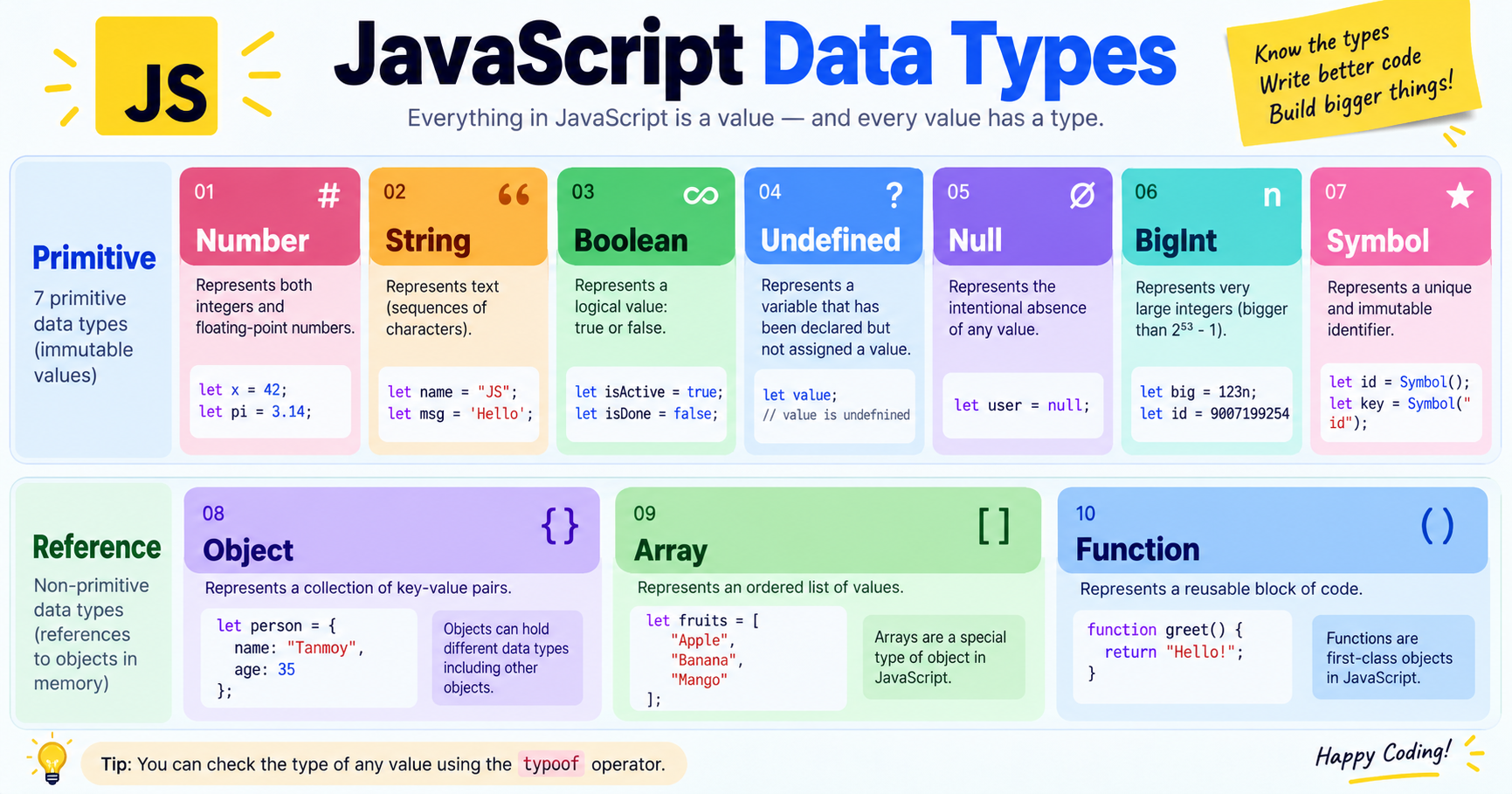
Astringis any piece of text wrapped in quotes:
All three quote styles work — butbackticks have a superpower: they let you embed variables with${ }:
Useful string tricks you'll use daily:
Unlike many languages, JavaScript hasone number typefor everything:
Math works exactly as you'd expect:
Two special number values to recognize:
⚠️ Famous quirk:
0.1 + 0.2equals0.30000000000000004, not0.3! This isn't a JavaScript bug — it's how all computers handle decimal math in binary. Round money calculations before displaying them.
Abooleanhas only two possible values — it's JavaScript's yes/no answer:
Booleans usually come fromcomparisons, and they power every decision your code will ever make:
undefinedmeans:a variable was declared, but nothing was ever put inside.JavaScript assigns this automatically — you rarely type it yourself.
nullmeans:a developer intentionally set this to "no value."
Symbols create values that areguaranteed unique, mainly used as object keys in advanced code:
Beginner verdict:know that they exist; you won't need them for months.
Regular numbers lose precision beyond about 15–16 digits.BigInthandles integers ofanysize — add ann:
Used in finance/cryptography apps. Also a "know it exists" type for now.
Primitives holdone simple value. Reference types holdcollections— and they behave differently in memory (we'll see why in a moment).
Anobjectgroups related data as key-value pairs:
Think of an object as aform: labeled fields, each holding a value.
Anarraystores multiple values in order, accessed by position (index):
Surprise: functions are also a reference type! That's why you can store them in variables:
How do you check a value's type? With thetypeofoperator:
Two famous surprises:
typeof []returns"object"— arrays ARE objects under the hood. To check for an array, useArray.isArray([1,2,3])→truetypeof nullreturns"object"— this is abug from 1995that can never be fixed (fixing it would break old websites). It's the most famous bug in programming history — now you can impress people at parties. 🎉This is the heart of the lesson — and the explanation for the mystery fromLesson 4.
Each variable gets itsown independent copy. Changing one never affects the other.
Why?With reference types, the variable doesn't hold the data itself — it holds theaddressof where the data lives in memory.cart2 = cart1copies theaddress, not the contents. Two labels, one box.
Use thespread operator(...) to make a true copy:
Two arrays/objects are compared byaddress, not contents.[1]and[1]are twodifferentboxes that happen to look alike — so JavaScript says "not the same."
JavaScript isdynamically typed— variables have no fixed type, and can change type mid-program:
Flexible? Yes. Risky? Also yes — this freedom causes real bugs, which is why many professional teams useTypeScript(JavaScript + enforced types) on big projects. That's a topic for much later in your journey, but now you knowwhyit exists.
typeof nullreturn, and why is it famous?console.log("5" + 3);cart2 = cart1NOT create a copy of an array?nullandundefined?(Answers: 1. Seven — e.g., string, number, boolean · 2. "object" — an unfixable bug from 1995 · 3. "53" — string concatenation wins · 4. The variable holds a memory address, so both point to the same array · 5. null = deliberately emptied by developer; undefined = never assigned, set automatically by JavaScript)
Understanding the mechanical differences between variable declarations and execution environments is critical for writing performant, bug-free modern JavaScript.
var vs let vs const| Feature / Property | var (Legacy ES5) | let (Modern ES6+) | const (Modern ES6+) |
|---|---|---|---|
| Scope | Function Scope | Block Scope ({}) | Block Scope ({}) |
| Hoisting Behavior | Hoisted (initialized as undefined) | Hoisted (Temporal Dead Zone - ReferenceError) | Hoisted (Temporal Dead Zone - ReferenceError) |
| Reassignable | ✓ Yes | ✓ Yes | ✗ No (Immutable binding) |
| Redeclarable in Same Scope | ✓ Yes (Error-prone) | ✗ No (SyntaxError) | ✗ No (SyntaxError) |
| Window Object Binding | Creates property on window | Does not attach to window | Does not attach to window |
| Dimension | Client-Side (Web Browser) | Server-Side (Node.js / Deno) |
|---|---|---|
| Global Object | window, document, navigator | global, process, globalThis |
| DOM & UI Manipulation | ✓ Full access (document.querySelector) | ✗ No DOM (Headless / Non-UI) |
| File System & OS Access | ✗ Blocked (Sandboxed security) | ✓ Full access (fs, os, child_process) |
| Primary Focus | Interactive UI, animations, client state | REST APIs, microservices, databases, I/O streaming |
// Primitive value copy
let a = 10;
let b = a;
b = 20;
console.log(a);
// 10
// Reference type copy
let obj1 = {
  name: 'John'
};
let obj2 = obj1;
obj2.name = 'Jane';
console.log(obj1.name);
// 'Jane'